
 FinTech Platform
Fortis
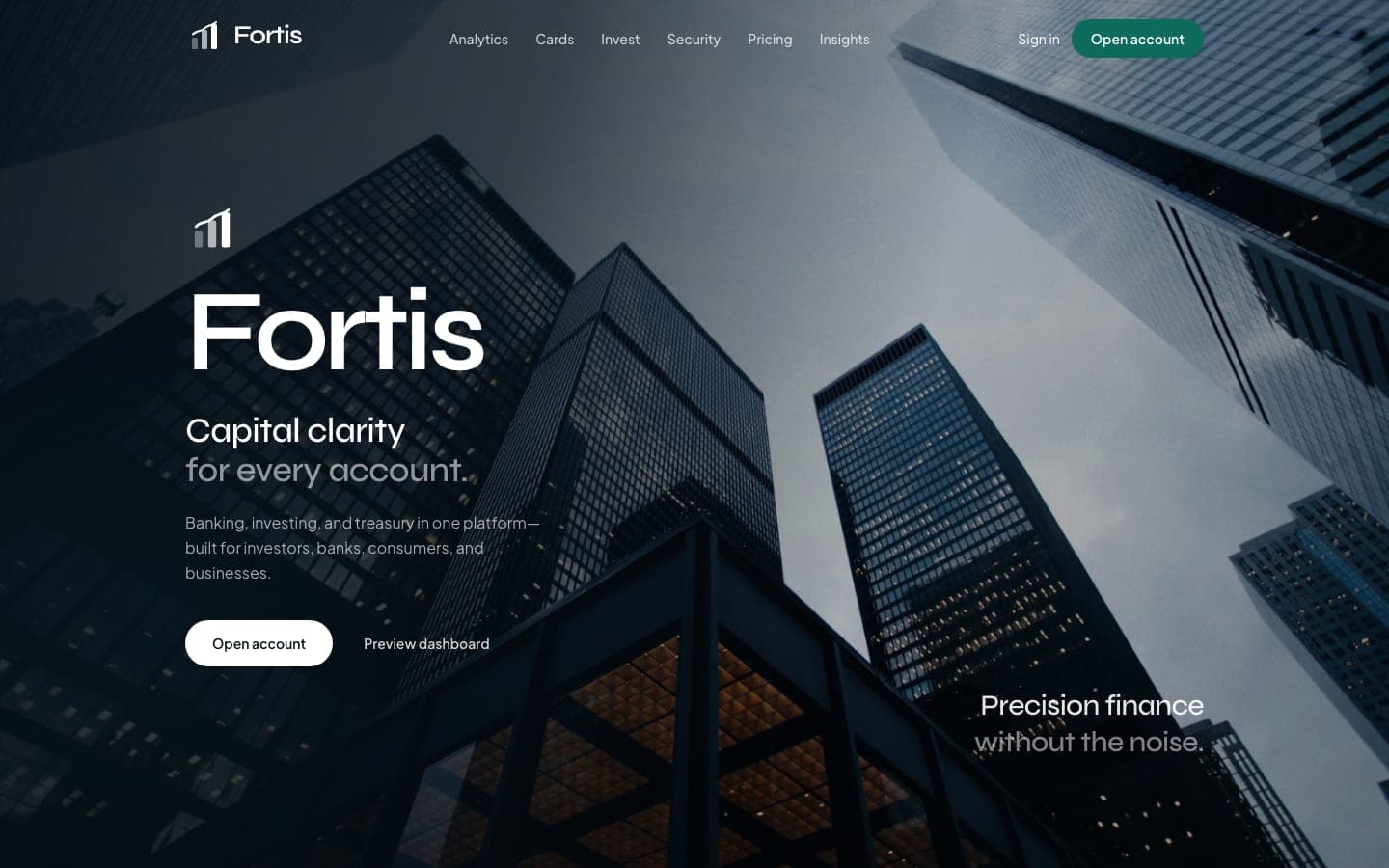
A banking, investing and treasury workspace that puts portfolio analytics, card controls and cash forecasting behind one interface.
Case study
A fintech app development company has two jobs that pull against each other: make dense financial data readable, and make security something a customer can see rather than take on trust. We built Fortis, a banking, investing and treasury platform, to work through exactly that tension, and the same thinking applies to lending, payments and wealth tools.
The constraints we plan for in the first call, because they decide the architecture.
An investor reads allocation heat maps; a consumer checks whether a payment cleared. If both use the same screens, one of them is badly served. The interface has to give each audience its own route into the same underlying data.
People hand over money to products they cannot inspect. Encryption, authentication and fraud monitoring only build confidence when the product explains them in plain language at the moment they matter, such as a card freeze or a new-device sign-in.
Floating-point arithmetic, rounding rules and currency conversion are a common source of silent bugs in financial software. Amounts need to be stored and calculated in a way that reconciles to the last unit, every time.
Banking APIs, card issuers, payment gateways and KYC providers sit behind most fintech products. They fail, rate-limit and change, so the build needs retries, idempotent requests and a clear state when a third party is down.
Portfolio curves, allocation breakdowns and cash forecasts designed as decision tools, with typography tuned for tabular data so figures can be compared at a glance.
Issue, freeze and limit cards in real time, with each action confirmed on screen and recorded in an activity log the customer can read.
Identity and document capture that resumes where a user left off, with the verification provider's responses translated into clear next steps instead of error codes.
The back-office views operations teams use: transaction search, exception queues, audit trails and exports that reconcile to the ledger.
Open the project to see the interface and read how it was designed.
We design to these requirements. We do not hold certifications on your behalf, and this is not legal advice.
Card data handling is designed around PCI DSS by keeping card numbers with a compliant processor or issuer and out of your own systems wherever possible.
Identity checks and transaction monitoring are normally provided by licensed vendors. We integrate them and design the review queues, while your compliance officer owns the policy and the thresholds.
We build against the OWASP Top 10, encrypt data in transit and at rest, and design consent and deletion flows to accommodate GDPR. Licensing for financial services is a regulatory matter between you and your regulator.
The disciplines this kind of project usually draws on.
Also see: Auto parts, Healthcare, Logistics, Real estate · Pricing
No. We are a software development company, not a regulated financial institution. We build products to meet the technical requirements regulators and partners set, and you or your licensed partner hold any licence the product needs.
It depends on how people will use it. Treasury and investing tools used at a desk suit a web app first, while payments and card controls are used on the move and usually need a mobile app early. We often build the web product first and add mobile once usage is clear.
Amounts are stored as integers in the smallest currency unit or as fixed-precision decimals, never as floating-point numbers, and every calculation has tests around rounding and currency conversion.
Yes, provided the provider offers an API. We build the integration with retries and idempotent requests so a timeout never creates a duplicate transaction, and we show the user a clear state while a request is pending.
Yes, and for new fintech ideas we recommend it. A clickable prototype of the core flow tests the idea with real users before the cost of security reviews, integrations and compliance work is committed.
Tell us what you need to build and who it is for. The first consultation is free.